
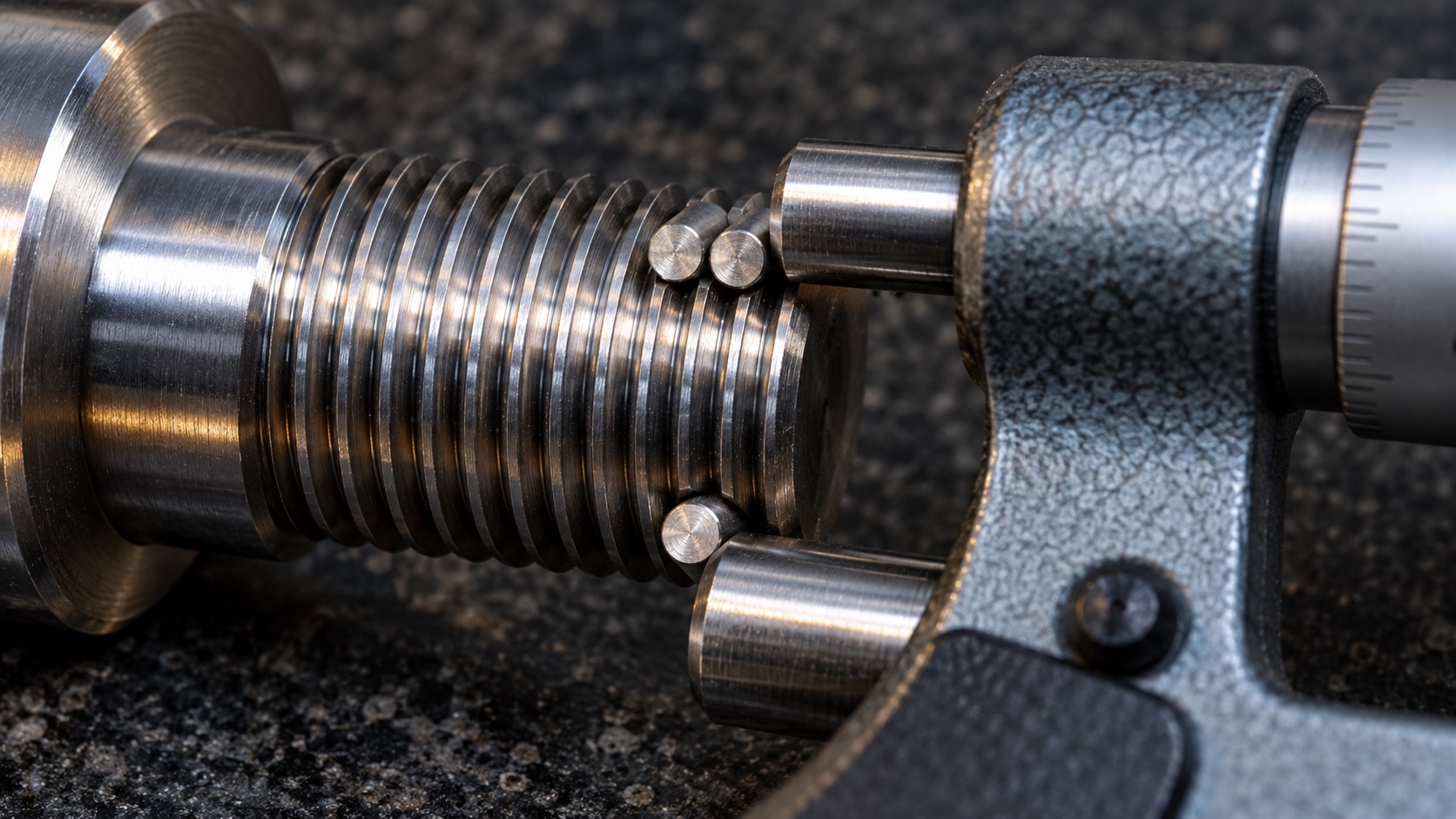
A plain micrometer measures the major diameter of a thread, which tells you little about fit. What decides whether a screw and nut engage is the pitch diameter, an imaginary cylinder that sits on the flanks. You cannot put an anvil on it. The three-wire method gets at it indirectly: lay three precision measuring pins in the thread grooves and measure over them.
Two wires go in adjacent grooves on one side of the thread and one wire in the groove opposite. The micrometer anvils close over the wires and the reading, M, is taken across all three. Because the wires touch the flanks at a known point, M is tied directly to the pitch diameter.
For a 60 degree metric thread on the ISO 68-1 basic profile, the best-size wire is w = 0.57735 x P. At that size the wire touches the flanks at the pitch line, so small errors in the flank angle barely affect the result. Use the nearest standard wire and recalculate, rather than a convenient wire that is far from best size.
For a 60 degree thread: pitch diameter d2 = M - 3w + 0.866025 x P, which rearranges to M = d2 + 3w - 0.866025 x P.
If the micrometer reads 12.379 mm over the wires, the pitch diameter is on its basic size. Compare the actual pitch diameter with the limits for the class on the drawing (tolerance classes follow ISO 965-1), for example 6g for an external thread; our callout guide explains the class.
Wires give you a number, useful for setting up a thread-rolling or cutting process and for investigating a rejected part. A thread ring or plug gauge gives a faster pass or fail at the machine. We make both the gauges and the cylindrical measuring pins for this work. Send the thread size and pitch and we will quote the matching wire set.
DSN Enterprises manufactures thread plug, ring and setting gauges to order in Coimbatore — metric, NPT, BSP, UNC and UNF — with NABL-traceable certificates.
Or call +91 93631 22005.

A buyer's guide to precision gauges that skips the catalogue and answers the questions that actually determine whether you get the right tool: tolerance, standard, material, volume, and supplier support.
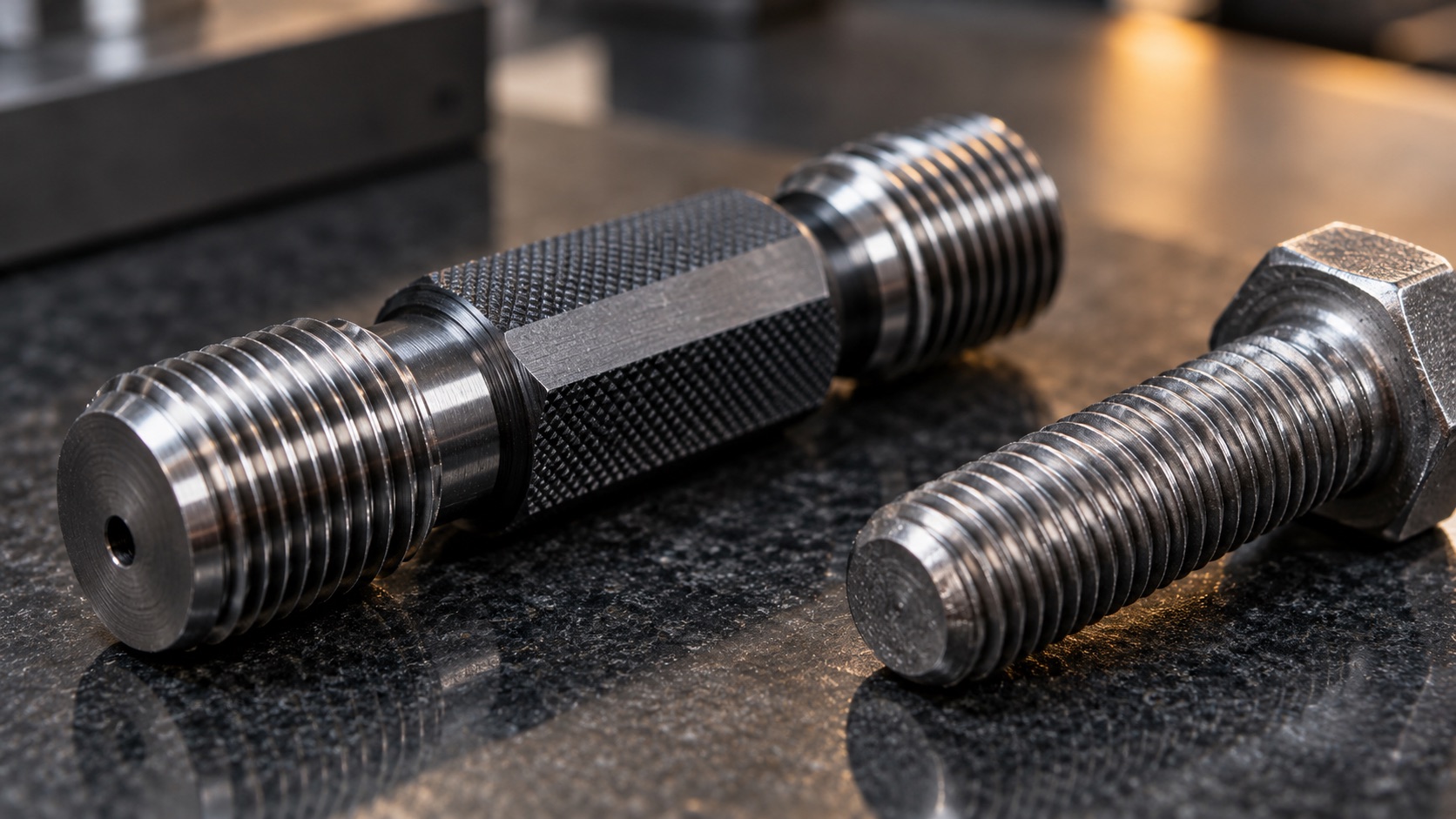
M12 and M12x1.25 share a diameter and little else. Knowing which pitch a drawing means decides which tap, which gauge and which pitch diameter you hold.
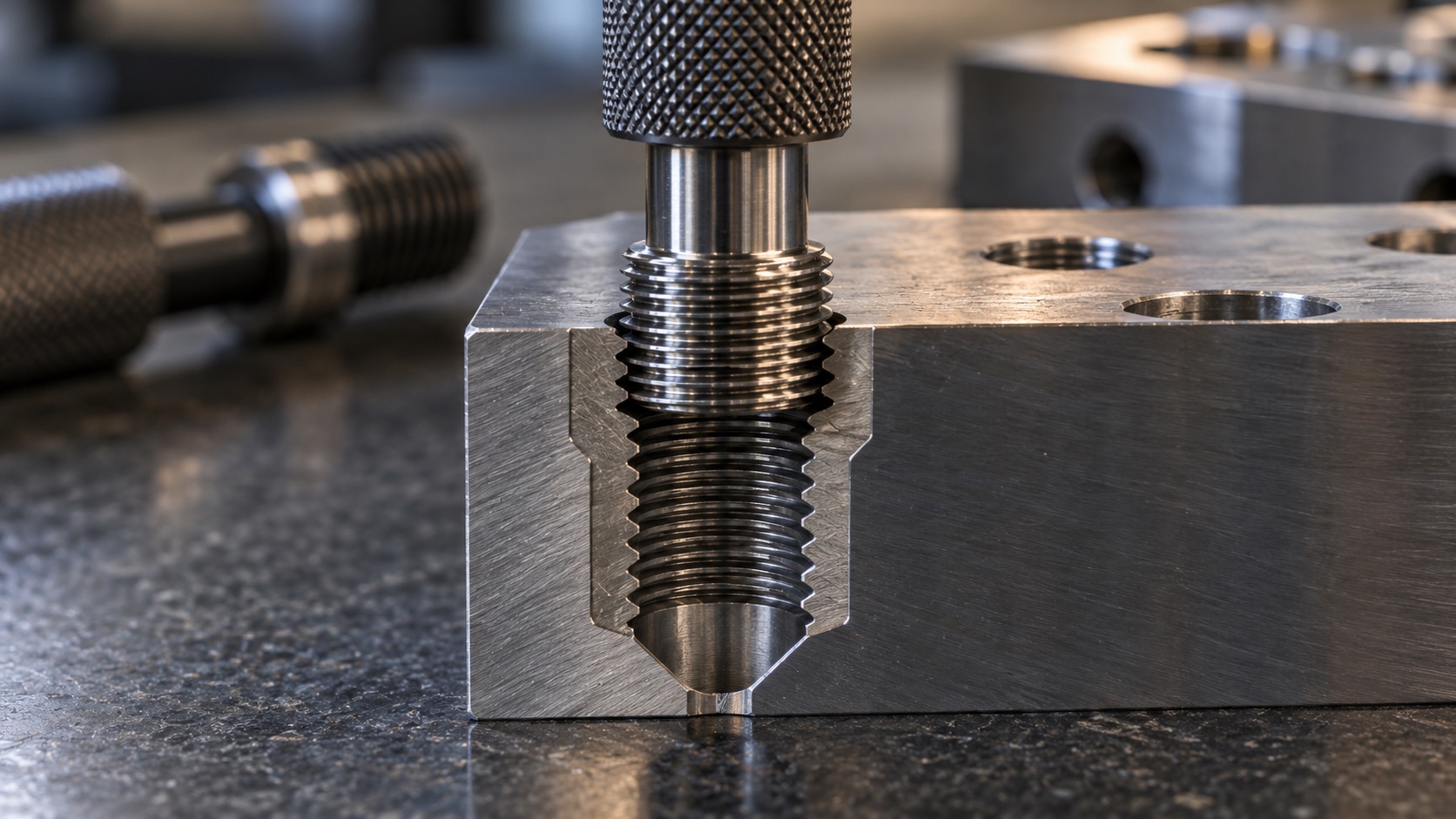
In a through hole the gauge runs out the far side. In a blind hole the thread ends in a drill point, and what the gauge can reach decides what you can claim about the thread.