

A drawing that says M12 and a drawing that says M12x1.25 both describe a 12 mm thread. They do not describe the same thread. The first is the coarse series, with a pitch of 1.75 mm. The second is a fine pitch. Everything downstream, from the tap to the gauge, depends on which one you meant.
When an ISO metric thread is called out with only a diameter, such as M8, M10 or M12, the pitch is the coarse one for that size. A fine pitch must be written out: M12x1.5 or M12x1.25. If the pitch is missing and the drawing intends a fine thread, the drawing is wrong, not the machinist.
The class that follows, such as 6H for an internal thread or 6g for an external one, sets the tolerance. Our guide to reading a full callout walks through each part.
Take M12. The coarse pitch is 1.75 mm; common fine pitches are 1.5 mm and 1.25 mm. The basic pitch diameter follows from the ISO 68-1 profile as d2 = d - 0.6495 x P:
The tap drill moves too. A rule of thumb is nominal diameter minus pitch, so about 10.25 mm for the coarse M12, where a 10.2 mm drill is the nearest standard size. The full tables for each size sit on our M12, M10 and M8 pages.
A thread plug gauge is cut for one pitch. A coarse M12 plug will not check an M12x1.25 hole: the flanks sit at different positions and the pitch diameter being controlled is a different number. This is the most common reason a shop orders the wrong gauge, and it is avoided by quoting the full designation, pitch and class included.
We make thread plug and ring gauges to order. See our thread gauges, or use the enquiry form with the designation and class.
DSN Enterprises manufactures thread plug, ring and setting gauges to order in Coimbatore — metric, NPT, BSP, UNC and UNF — with NABL-traceable certificates.
Or call +91 93631 22005.
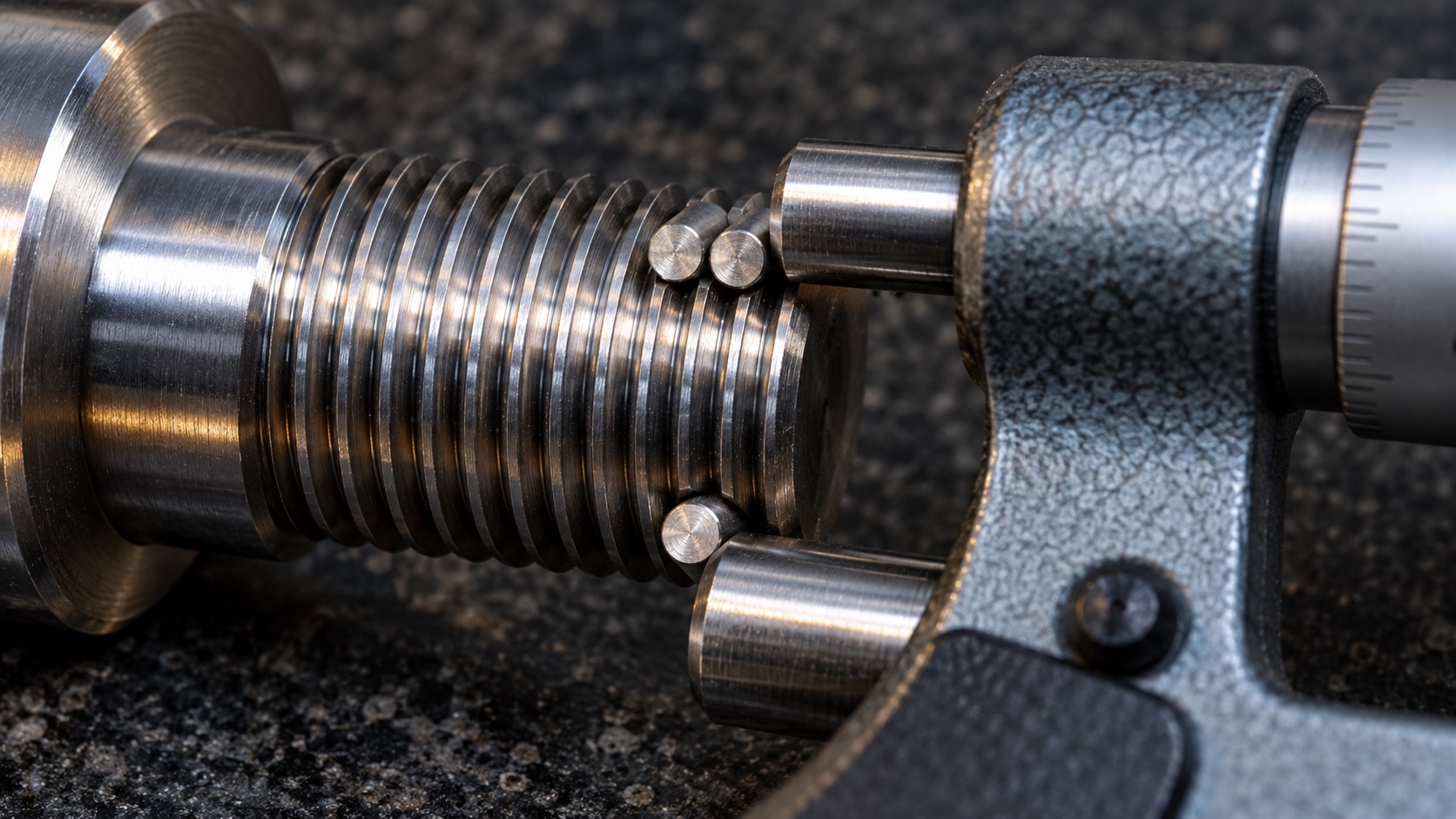
Pitch diameter is the number that decides whether a thread fits, and you cannot reach it with a plain micrometer. Three precision wires and a micrometer can, if you pick the right wire size and trust the arithmetic.

An order for an 'M20 thread gauge' is missing three of the four things needed to make one. Each element of a metric callout, and what an omission does.

In a through hole the gauge runs out the far side. In a blind hole the thread ends in a drill point, and what the gauge can reach decides what you can claim about the thread.